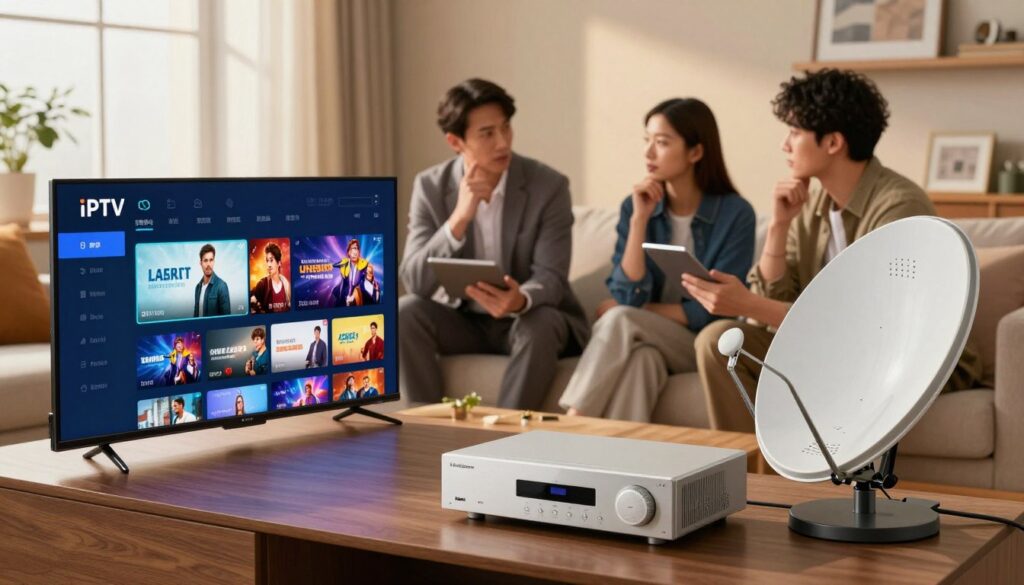
Choosing the right way to watch your favorite shows can feel overwhelming in today’s digital world. Many households in the United States are currently weighing the benefits of traditional Satellite TV against the rise of modern IPTV services. Both platforms offer unique ways to enjoy home entertainment, but they function in very different ways.
While satellite systems rely on dish signals from space, internet-based streaming delivers content directly through your broadband connection. Understanding these core differences is the first step toward finding a setup that fits your lifestyle. Whether you prioritize reliability or cutting-edge features, selecting the right entertainment source is essential for a high-quality viewing experience. Let’s explore how IPTV and Satellite TV stack up against each other to help you make an informed decision.
Key Takeaways
- Satellite TV uses dish technology to receive signals from orbiting satellites.
- IPTV delivers television content over your existing high-speed internet connection.
- Reliability often depends on your local weather conditions for satellite users.
- Internet-based services offer more flexibility and on-demand viewing options.
- Choosing the right service depends on your budget, location, and internet speed.
Understanding the Core Technologies
Modern television delivery relies on two distinct technological paths to bring entertainment into your living room. While both methods aim to provide high-quality video, the infrastructure required to make this happen is fundamentally different. Grasping these technical foundations helps clarify why one service might be a better fit for your specific home environment.
How IPTV Delivers Content Over Broadband
IPTV, or Internet Protocol Television, functions by sending television signals through your existing internet connection. Instead of traditional broadcast waves, this system breaks down video content into small data packets.
These packets travel across your broadband network directly to your home router. Once the data arrives, your set-top box or smart TV reassembles these packets into a seamless stream of high-definition video. Because this process relies on a two-way connection, it allows for interactive features like video-on-demand and personalized content recommendations.

The Mechanics of Satellite Signal Transmission
Satellite television operates on an entirely different principle that does not require a wired internet connection. This technology utilizes geostationary satellites orbiting high above the Earth to beam signals directly to your property.
Your home must have a clear line-of-sight to the southern sky to capture these signals with a mounted dish. The receiver then processes the incoming data and converts it into the channels you watch daily. This method is highly effective for reaching remote areas where wired infrastructure might be limited or unavailable.
To summarize the primary differences between these two systems, consider the following technical factors:
- IPTV requires a stable broadband connection to maintain consistent stream quality.
- Satellite TV relies on a direct line-of-sight to a satellite, making it independent of local internet congestion.
- IPTV offers greater flexibility for on-demand services due to its bidirectional data flow.
- Satellite systems are often the preferred choice in rural regions where high-speed broadband is not yet fully deployed.
The Evolution of IPTV in the United States
Modern households are rapidly abandoning legacy cable systems in favor of more flexible digital solutions. This transition marks a significant turning point in how Americans access entertainment, news, and sports. As viewers demand more control over their viewing schedules, the industry has pivoted toward IPTV to meet these evolving needs.
Shift from Traditional Cable to Internet-Based Streaming
For decades, cable television dominated the American market through rigid, bundled packages. Today, the rise of streaming services has fundamentally altered this dynamic by offering personalized, on-demand content. Consumers now prefer the freedom to watch their favorite shows whenever and wherever they choose.
This shift is driven by several key factors that make digital delivery more attractive than traditional broadcast methods:
- Cost-efficiency: Users can subscribe only to the services they actually watch.
- Portability: Content is accessible across multiple devices, including tablets and smartphones.
- Interactivity: Viewers enjoy features like pause, rewind, and cloud-based recording.

The Role of High-Speed Fiber and 5G Networks
The success of modern IPTV relies heavily on the robust digital infrastructure currently being deployed across the United States. High-speed Fiber connections provide the stable, high-bandwidth foundation necessary for high-definition video delivery without interruptions. Without this reliable backbone, the seamless experience that users expect would be impossible to maintain.
Furthermore, the expansion of 5G networks is extending the reach of high-quality streaming to mobile users everywhere. This wireless advancement ensures that even those away from home can enjoy consistent, low-latency video playback. By combining the power of Fiber and 5G, the United States is building a future where television is truly ubiquitous and highly responsive to user demand.
How Satellite TV Maintains Its Market Presence
While digital streaming dominates headlines, Satellite TV remains a cornerstone of American home entertainment. Even as urban centers shift toward fiber-optic connections, this technology continues to serve a vital role for millions of households across the country.

Serving Rural and Underserved Regions
Geography often dictates the type of connectivity available to a home. In many rural and mountainous areas, laying down physical cables is simply not economically feasible for service providers.
This is where Satellite TV shines by providing a universal signal that reaches virtually any location with a clear view of the southern sky. Residents in these regions rely on this technology for:
- Consistent access to national news and emergency broadcasts.
- A wide variety of entertainment options without needing high-speed broadband.
- Reliable service in areas where traditional infrastructure is absent.
Bundling Strategies with Telecommunications Providers
To maintain a loyal customer base, many companies have adopted clever bundling strategies. By pairing Satellite TV with phone or internet services, providers create a comprehensive package that is difficult for consumers to walk away from.
These partnerships allow major telecommunications firms to offer competitive pricing that keeps costs manageable for families. When you combine multiple services into one monthly bill, the overall value often outweighs the convenience of standalone streaming apps.
Ultimately, these strategic alliances ensure that Satellite TV remains a relevant and cost-effective choice for diverse demographics. By focusing on accessibility and integrated service models, providers continue to secure their place in the modern media landscape.
Comparing IPTV and Satellite TV Performance
Technical performance metrics like speed and clarity define the modern home entertainment landscape. When you sit down to watch a movie or a live game, you expect a seamless experience without interruptions. Understanding how different delivery methods handle data helps you choose the right service for your home.
Latency and Buffering Issues
One of the most common frustrations for viewers is latency, which refers to the delay between the broadcast and the image appearing on your screen. IPTV relies on your home internet connection, meaning that heavy network traffic can lead to annoying buffering. If your household has multiple devices streaming or gaming simultaneously, your TV signal may struggle to maintain a steady flow.
In contrast, Satellite TV operates on a dedicated broadcast frequency that is independent of your home internet usage. Because it does not compete for bandwidth with your laptop or smartphone, it often provides a more consistent experience during peak hours. While satellite signals can experience slight delays, they are generally immune to the local network congestion that plagues internet-based streaming.
Picture Quality and Resolution Standards
Visual fidelity is another critical area where these two technologies diverge. Resolution standards have evolved rapidly, with 4K and Ultra HD becoming the new benchmarks for high-end displays. IPTV services often use adaptive bitrate streaming, which adjusts the quality of the video based on your current internet speed to prevent total signal loss.
Satellite TV typically delivers a more stable, high-bitrate signal that does not fluctuate based on your home network activity. This often results in a crisper, more reliable image that remains consistent regardless of how many people are using the Wi-Fi. While both platforms are capable of delivering stunning high-definition content, the underlying delivery method dictates how often you see that quality at its peak.
Cost Analysis and Subscription Models
When choosing between television services, the total cost often goes far beyond the advertised monthly rate. Many households focus solely on the base price, but understanding the full range of subscription models is vital for long-term savings. Taking a closer look at your bill can reveal significant differences in how providers charge for their services.
Hidden Fees and Equipment Rental Costs
One of the most common ways providers increase your bill is through hidden fees. These often include regional sports surcharges, broadcast TV fees, and administrative costs that are not always clear in initial advertisements.
Furthermore, equipment rental is a major factor that can inflate your monthly expenses. While some IPTV services allow you to use your own smart devices, satellite providers frequently require proprietary hardware. You might find yourself paying a monthly fee for every receiver or DVR unit in your home, which adds up quickly over time.
Contractual Obligations vs. Month-to-Month Flexibility
The structure of your agreement plays a massive role in your financial freedom. Traditional satellite providers often require long-term contracts, sometimes spanning two years, to secure promotional pricing. Breaking these agreements early can lead to hefty early termination fees that catch many consumers off guard.
In contrast, many modern IPTV services offer month-to-month flexibility. This model allows you to cancel or pause your service without the fear of being locked into a rigid contract. By choosing a provider that aligns with your financial habits, you can maintain better control over your entertainment budget while avoiding unnecessary equipment rental costs associated with outdated subscription models.
Content Variety and On-Demand Capabilities
The way we consume media has shifted dramatically toward a blend of live and on-demand options. Modern households no longer settle for rigid broadcast schedules that dictate when they must sit in front of the television. Instead, viewers now prioritize platforms that offer a seamless transition between real-time events and vast digital archives.
Access to Live Sports and Local Channels
For many families, the ability to watch live sports remains the most critical factor in choosing a television provider. Whether it is professional football on Sunday or local basketball games, fans demand low-latency delivery to stay connected with the action. Traditional satellite services have long dominated this space by providing reliable access to regional networks and national sports channels.
Local channels also play a vital role in keeping communities informed about weather updates and regional news. While IPTV providers are rapidly expanding their local channel lineups, satellite remains a strong contender for those who prioritize traditional broadcast reliability. Ensuring that your service includes these essential channels is a key step in maintaining a well-rounded home entertainment setup.
The Advantage of Integrated Streaming Libraries
The true power of modern streaming lies in the ability to access thousands of titles at the touch of a button. Unlike traditional linear television, IPTV platforms often integrate popular apps directly into the user interface. This allows viewers to jump from a live broadcast to an on-demand movie without switching inputs or devices.
This convergence of media types creates a more personalized experience for the end user. By combining live sports with massive streaming libraries, providers can cater to both the casual viewer and the dedicated binge-watcher. The following table outlines how these platforms compare in terms of content delivery and flexibility.
| Feature | Satellite TV | IPTV |
|---|---|---|
| Live Sports Access | Excellent (High Reliability) | Good (Requires Stable Internet) |
| On-Demand Library | Limited/External | Highly Integrated |
| Local Channel Availability | Broad Coverage | Varies by Region |
| User Interface | Traditional Grid | Modern/Interactive |
Reliability and Weather Dependency
Reliability remains a top priority for households, yet both Satellite TV and internet-based systems have distinct vulnerabilities. Choosing the right service often involves weighing how these technologies handle external disruptions. Understanding these limitations helps you set realistic expectations for your home entertainment setup.
Rain fade and Atmospheric Interference in Satellite
One of the most well-known challenges for Satellite TV users is a phenomenon called rain fade. This occurs when heavy precipitation, such as intense rain or thick snow, absorbs or scatters the radio waves traveling between the satellite and your dish. When the signal strength drops below a certain threshold, your picture may pixelate or disappear entirely.
While modern equipment is designed to be more resilient, severe weather events can still cause temporary outages. It is important to note that this rain fade is usually short-lived, lasting only as long as the storm remains directly in the signal path. Most providers offer high-quality hardware that minimizes these interruptions, but they remain a reality of space-to-ground communication.
Network Congestion and ISP Stability in IPTV
In contrast, IPTV relies heavily on your local broadband connection to deliver content. If your internet service provider experiences high traffic, you might encounter network congestion during peak evening hours. This often results in buffering, lower resolution, or sudden drops in stream quality.
The stability of your broadband connection is the backbone of a smooth viewing experience. If your home network is shared among many devices or if your ISP has limited bandwidth, your television service may struggle to maintain a consistent feed. Investing in a high-speed, stable broadband plan is often the best way to ensure your streaming remains uninterrupted, regardless of the weather outside.
Installation Requirements and Hardware Needs
Setting up a new television service often feels like a daunting task, but knowing your equipment makes all the difference. The complexity of your installation depends entirely on whether you choose a modern internet-based service or a traditional broadcast provider. Understanding these differences helps you prepare your home for a smooth transition to your new entertainment setup.
Professional Installation vs. DIY Setup
Most satellite providers require a professional technician to visit your home. This is necessary because mounting satellite dishes on a roof or exterior wall requires precision and safety equipment. A technician must ensure the hardware is securely fastened and perfectly aligned to receive a signal from space.
In contrast, modern IPTV services often offer a simple, DIY-friendly setup. Since these systems rely on your existing home broadband connection, you usually only need to connect a device to your router. Most users can complete this process in minutes without needing a professional to drill holes or climb ladders.
Hardware Requirements: Set-top boxes and Satellite dishes
When you opt for satellite television, the hardware list is quite specific. You will need a mounting bracket, cabling, and the dish itself, which must have a clear line-of-sight to the southern sky. Any obstructions like trees or tall buildings can block your signal, making the initial site survey a critical part of the process.
IPTV services are generally less demanding regarding physical hardware. You will typically receive set-top boxes that connect directly to your television via an HDMI cable. Some providers even allow you to use apps on your smart TV, which eliminates the need for extra hardware entirely. This flexibility makes set-top boxes a popular choice for renters or those who prefer a clutter-free living room.
User Experience and Interface Design
A seamless interface is the secret ingredient to a truly enjoyable home viewing experience. When you sit down to relax, the last thing you want is a complicated menu that hides your favorite Entertainment options. Modern platforms prioritize intuitive layouts to ensure that every viewer can find their preferred content with minimal effort.
Navigating Electronic Program Guides
Traditional television relied on static lists, but today’s Electronic program guides have evolved into dynamic hubs. These guides now offer rich metadata, including high-resolution posters, cast information, and plot summaries. By providing a visual snapshot of what is airing, these tools help users make quick decisions without endless scrolling.
Advanced search filters allow you to sort by genre, release year, or even critic ratings. This level of control transforms the guide from a simple schedule into a powerful discovery engine. Efficiency is the primary goal, ensuring that you spend less time searching and more time watching.
Personalization and Recommendation Algorithms
Modern IPTV platforms take the viewing experience a step further by utilizing sophisticated machine learning. These systems analyze your watch history to suggest new titles that align with your unique tastes. By curating a personalized feed, these algorithms act as a digital concierge for your daily Entertainment needs.
The beauty of these systems lies in their ability to learn over time. As you rate shows or skip certain genres, the platform refines its suggestions to become more accurate. This personalized approach ensures that your home screen remains relevant, highlighting content you are actually likely to enjoy.
Future Trends in Television Distribution
The future of home entertainment is moving away from rigid schedules toward personalized experiences. As technology advances, the entire framework of television distribution is undergoing a profound transformation. Viewers now demand more control over what they watch and when they watch it.
The Decline of Linear Programming
For decades, linear programming dictated the rhythm of our daily lives. Families would gather at specific times to catch their favorite shows, but that era is fading fast. Today, the convenience of streaming has made traditional broadcast schedules feel outdated and restrictive.
“The future of television is not about channels, but about the content that finds you exactly when you are ready to engage with it.”
Most modern households now prefer on-demand libraries over scheduled broadcasts. This shift forces providers to rethink their strategies to remain relevant in a digital-first market. The transition toward time-shifted content is no longer just a trend; it is the new standard for television distribution.
Integration of Artificial Intelligence in Content Discovery
With thousands of titles available at our fingertips, finding something to watch can often feel overwhelming. This is where artificial intelligence steps in to simplify the process. Smart algorithms analyze your viewing habits to suggest media that aligns perfectly with your personal tastes.
By leveraging artificial intelligence, platforms can curate unique experiences for every user. This technology reduces the time spent scrolling through menus and increases the time spent enjoying high-quality streaming content. As these systems become more sophisticated, the barrier between the viewer and their next favorite show will continue to disappear.
Conclusion
Choosing the right television service requires a clear look at your personal viewing habits. Satellite television remains a dependable partner for households in rural regions where high-speed internet access might be limited. It provides a consistent signal that reaches remote corners of the United States with ease.
IPTV offers a different path for those who prioritize flexibility and modern features. Services like YouTube TV or Hulu + Live TV leverage your broadband connection to deliver a personalized experience. These platforms bring advanced recommendation algorithms and on-demand libraries directly to your screen.
Your decision rests on balancing your geographic reality with your appetite for innovation. Evaluate your current internet stability and your budget before committing to a long-term contract. The shift toward internet-based television marks a major milestone in the evolution of home entertainment. Embrace the technology that best fits your lifestyle to enjoy the best content available today.
FAQ
Which service is better for viewers living in rural areas?
For those living in more remote parts of the United States where high-speed fiber infrastructure hasn’t yet reached, Satellite TV remains the top choice. Providers like DISH Network and DIRECTV utilize geostationary satellites to beam signals directly to your home, ensuring you have access to hundreds of channels regardless of how far you are from a major city.
Does weather really affect my television signal?
Yes, it can. Satellite TV is susceptible to a phenomenon known as rain fade, where heavy clouds, rain, or snow can temporarily disrupt the signal between the satellite and your dish. In contrast, IPTV services like Hulu + Live TV or YouTube TV are unaffected by local weather, though they do depend entirely on the stability of your Internet Service Provider (ISP) like Xfinity or Spectrum.
Can I watch 4K content on both IPTV and Satellite?
Both platforms offer 4K resolution, but the delivery differs. DIRECTV offers dedicated 4K channels for crystal-clear sports and movies. Meanwhile, IPTV platforms like Netflix and Amazon Prime Video provide a massive library of 4K content, provided your broadband connection has enough bandwidth (usually at least 25 Mbps) to handle the data load without buffering.
Do I need a professional to install my TV service?
A: Satellite TV almost always requires a professional technician to mount the dish and ensure it has a clear line-of-sight to the southern sky. IPTV is much more DIY-friendly. In most cases, you simply plug in a device like an Apple TV 4K, Roku, or Amazon Fire Stick, connect to your Wi-Fi, and start streaming immediately.
Will I be locked into a long-term contract?
This is one of the biggest differences between the two. Traditional Satellite TV providers often require 12-month or 24-month contracts. On the flip side, IPTV services are famous for their month-to-month flexibility, allowing you to cancel or switch services like Sling TV or FuboTV whenever you like without paying hefty early termination fees.
How does the channel surfing experience compare?
A: Satellite TV offers a classic, instantaneous channel-changing experience. IPTV interfaces, such as those found on the Nvidia Shield or Google TV, rely on Electronic Program Guides (EPG) and advanced AI algorithms to recommend content based on your viewing habits. While there might be a slight latency when switching streams, the level of personalization on IPTV is generally much higher.
Can I still get local news and live sports without a dish?
Absolutely! Many IPTV providers have secured local broadcast rights. For example, YouTube TV is the current home of the NFL Sunday Ticket, and most major streaming services carry local ABC, CBS, and NBC affiliates. You get the same live coverage you’d expect from a traditional provider but with the added benefit of integrated streaming libraries.
What equipment do I need to get started with IPTV?
To enjoy IPTV, you just need a reliable internet connection and a compatible device. Many modern Smart TVs from brands like Samsung and LG have these apps built-in. If not, a simple HDMI streaming dongle or an Ethernet-connected set-top box will do the trick, eliminating the need for bulky outdoor hardware.